
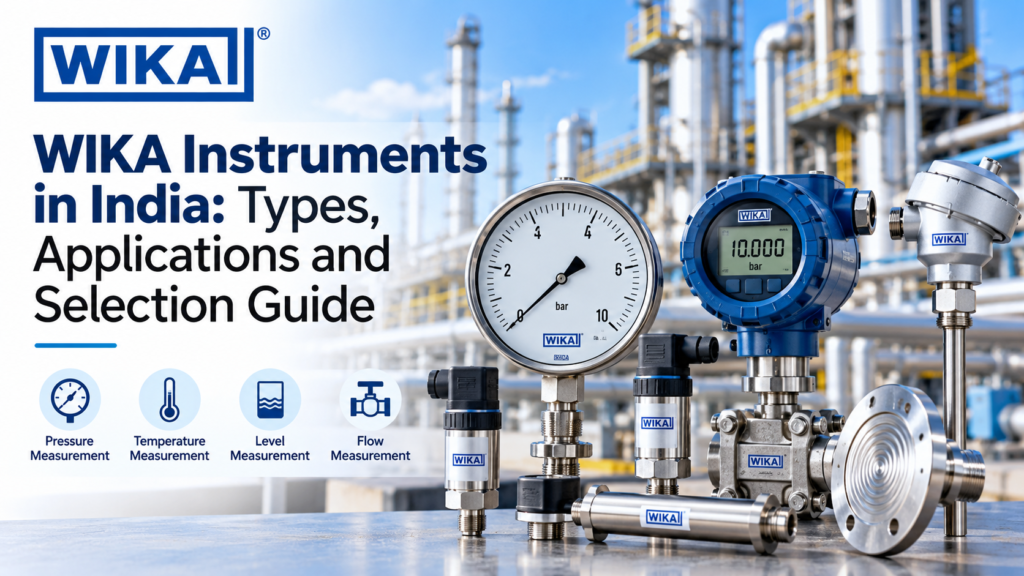
WIKA instruments in India cover pressure, temperature, level, and flow measurement technologies used across CGD, CNG, CBG, oil & gas, and process industries. Selecting the right WIKA instrument depends on matching pressure range, temperature range, media compatibility, connection type, and installation conditions to your specific process requirements. MechTech Energies, a WIKA instruments supplier in India, helps industrial buyers identify suitable products based on application data.
Industrial buyers across India rely on WIKA instrumentation for one simple reason: accurate measurement keeps plants safe and processes running. Whether it’s a CNG dispensing station monitoring line pressure or a pharmaceutical facility tracking process temperature within tight tolerances, the instrument on the panel is only as good as its fit for the application.
The challenge most procurement managers and engineers face isn’t finding WIKA products—it’s knowing which variant, range, and configuration actually suits their process. WIKA’s catalog spans pressure gauges, temperature sensors, level switches, and flow measurement devices, each with multiple sub-categories built for different media, pressures, and environments. Picking the wrong one doesn’t just waste budget; it can introduce safety risks or compliance gaps during an audit.
This guide breaks down the major categories of WIKA instruments available in India, explains where each type applies, and walks through the selection criteria that matter most for plant managers, EPC contractors, and industrial buyers sourcing instrumentation for CGD, CNG, CBG, oil & gas, and general process applications.
What Types of WIKA Instruments Are Available in India?
WIKA’s instrumentation portfolio in India covers four core measurement categories: pressure, temperature, level, and flow. Each category includes multiple product families designed for specific process conditions.
WIKA Pressure Instruments
Pressure measurement is WIKA’s most extensive product line, and for good reason—pressure monitoring sits at the center of most industrial safety and process control systems. The pressure instrument range includes:
- Pressure gauges: Mechanical bourdon tube gauges for general-purpose pressure indication.
- Digital pressure gauges: Electronic display units for applications needing higher readability or data logging.
- Pressure sensors and transmitters: Convert pressure readings into electronic signals for integration with control systems.
- Process transmitters: Built for more demanding process conditions, often with enhanced accuracy and diagnostic capability.
- Pressure switches: Trigger alarms or shutdowns when pressure crosses a defined threshold.
- Differential pressure instruments: Measure the difference between two pressure points, commonly used in filtration and flow applications.
- Diaphragm seals: Protect the instrument from direct contact with corrosive, viscous, or high-temperature media.
- Pressure gauge valves, manifolds, and contact pressure gauges: Supporting components for isolation, calibration, and alarm functions.
Choose mechanical pressure gauges for straightforward, non-critical applications where a visual, local reading is sufficient. Choose electronic pressure transmitters when the reading needs to feed into a control system, SCADA network, or remote monitoring setup—this matters more for CGD and CNG stations where centralized pressure monitoring supports both safety and operational efficiency.
WIKA Temperature Instruments
Temperature measurement products from WIKA include:
- Thermocouples: Cost-effective sensors suited to a wide temperature range, commonly used across general industrial processes.
- Resistance thermometers (RTDs): Offer higher accuracy and stability than thermocouples, often preferred for processes requiring tighter tolerance.
- Temperature transmitters: Convert sensor signals into standardized outputs for control systems.
- Temperature switches: Trigger alarms or control actions at defined temperature thresholds.
- Dial thermometers: Provide local, visual temperature readings without electronic output.
- Thermowells: Protect temperature sensors from direct process contact, allowing removal without shutting down the process.
- Temperature controllers and digital indicators: Support process control loops and local readouts.
Choose an RTD over a thermocouple if your application demands higher measurement accuracy and operates within a moderate temperature range. Choose a thermocouple if your process involves extreme temperatures that exceed typical RTD limits, or if budget constraints make the thermocouple’s lower cost more practical.
WIKA Level Instruments
Level measurement instruments help monitor and control fluid levels in tanks, vessels, and process equipment. WIKA’s level portfolio includes:
- Bypass level indicators: Provide a visual indication of level in a separate chamber connected to the main vessel.
- Submersible pressure sensors: Measure hydrostatic pressure to determine liquid level, suited for open tanks and wells.
- Float switches: Trigger alarms or pump controls at specific level points.
- Glass level gauges: Offer direct visual level observation for process vessels.
- Magnetic float switches: Combine a float mechanism with magnetic switching for reliable point-level detection.
- Optoelectronic level switches: Use optical sensing for point-level detection, often in applications where mechanical moving parts are undesirable.
The right level instrument depends on the medium being measured, tank configuration, pressure and temperature conditions, and whether continuous or point-level monitoring is required. A corrosive or viscous medium, for instance, may rule out certain mechanical float designs in favor of non-contact or optoelectronic alternatives.
WIKA Flow Measurement Products
Flow measurement products from WIKA focus primarily on differential pressure-based flow sensing elements, including:
- Orifice plates: A common, cost-effective method for flow measurement using a calibrated restriction.
- Meter runs: Pre-engineered pipe sections incorporating flow measurement elements for accurate installation.
- Flow nozzles: Used in higher-velocity flow applications where orifice plates may not hold up as well.
- Venturi tubes: Provide accurate flow measurement with lower permanent pressure loss compared to orifice plates.
- Pitot tubes: Measure flow velocity at a single point, often used for larger pipe diameters.
- Restriction orifices: Control or limit flow rate rather than measure it precisely.
- Flow switches and air flow sensors: Detect flow presence or absence for safety interlocks and process control.
Where Are WIKA Instruments Used Across Indian Industries?
WIKA instrumentation supports a wide range of industrial applications in India, each with distinct measurement demands.
CNG and CBG Infrastructure
Pressure monitoring plays a central role across CNG and CBG infrastructure—from compression stations to dispensing units. WIKA pressure measurement products are relevant wherever operators need to monitor, measure, or control pressure within gas compression, storage, and dispensing systems. Given the safety-critical nature of compressed gas handling, accurate and reliable pressure instrumentation is a baseline requirement rather than an optional upgrade.
CGD and Industrial Gas Applications
City gas distribution networks and industrial gas systems depend on consistent pressure and process measurement across pipelines, regulating stations, and metering points. WIKA lists industrial gases among its served industries, reflecting the breadth of its product fit for this sector. For CGD operators managing extensive pipeline networks, standardizing on a reliable instrumentation supplier helps simplify maintenance, calibration, and spare parts planning across multiple sites.
Oil & Gas and Process Industries
WIKA’s portfolio extends into oil & gas and broader process industries, including chemical, petrochemical, pharmaceutical, power generation, and water and wastewater treatment. These sectors often involve more demanding conditions—corrosive media, extreme temperatures, hazardous area classifications—which is why application-specific instrument selection matters more here than in general manufacturing settings.
How Do You Choose the Right WIKA Instrument for Your Application?
Selecting the correct WIKA instrument comes down to matching the product to your actual process conditions rather than defaulting to the most familiar or lowest-cost option.
Define the Application and Process Requirements
Start by identifying what you’re measuring and why. Is it a safety-critical pressure reading feeding into a shutdown system, or a general indication for routine monitoring? This distinction shapes whether you need a basic mechanical gauge or an electronic transmitter with diagnostic capability.
Confirm Pressure and Temperature Range
Every WIKA instrument is rated for a specific operating range. Choose a product rated comfortably above your expected maximum pressure or temperature, rather than one operating near its upper limit, to avoid premature wear or inaccurate readings over time.
Identify the Media Being Measured
Corrosive, viscous, or particulate-laden media often require protective measures like diaphragm seals or specialized wetted materials. Choose a diaphragm seal configuration if your process media could damage a standard instrument’s internals or create maintenance headaches over time.
Check Connection and Material Requirements
Mounting type, process connection size, and wetted material compatibility all affect whether an instrument will install and perform correctly. Mismatched connections or incompatible materials are common causes of installation delays and premature instrument failure.
Account for Accuracy Requirements
Not every application needs laboratory-grade accuracy. Choose a higher-accuracy instrument, such as an RTD over a thermocouple, when your process tolerance is tight and small measurement errors carry real operational or safety consequences. For less critical, general-purpose monitoring, a standard-accuracy instrument is often sufficient and more cost-effective.
Consider Installation Conditions
Vibration, ambient temperature extremes, hazardous area classifications, and accessibility for maintenance all factor into instrument selection. An instrument that performs well in a climate-controlled lab may not hold up on a vibrating compressor skid or in an outdoor CNG station exposed to monsoon conditions.
Buyers evaluating suppliers for these products should also weigh the supplier’s ability to support application-based selection and documentation. MechTech Energies’ guide to choosing a WIKA supplier in India covers additional criteria, including verifying authorized distributor status and assessing after-sales calibration support.
How Can MechTech Energies Help You Source WIKA Instruments?
MechTech Energies supplies WIKA measurement and instrumentation products for industrial and process applications across India, including pressure, temperature, level, and flow measurement requirements. As a WIKA instruments supplier, MechTech Energies helps customers identify the appropriate instrument based on application details such as pressure range, temperature range, media type, connection requirements, and installation conditions.
For businesses working on CNG, CBG, CGD, industrial gas, oil & gas, or general process applications, this kind of application-based product selection reduces the risk of specifying the wrong instrument and helps avoid costly rework or compliance issues down the line.
Making the Right Instrumentation Decision
Choosing the right WIKA instrument isn’t about picking the most recognizable product name off a catalog page. It’s about matching pressure range, temperature range, media compatibility, and installation conditions to your actual process, then sourcing through a supplier who can support that selection process with technical input.
Industrial buyers, procurement managers, and EPC contractors working on pressure, temperature, level, or flow measurement requirements in India can reach out to MechTech Energies’ WIKA supplier page with their technical specifications to request product availability and a quotation.
Frequently Asked Questions
What is the difference between a WIKA pressure gauge and a pressure transmitter?
A WIKA pressure gauge provides a local, visual pressure reading using mechanical components, while a pressure transmitter converts the pressure reading into an electronic signal for integration with a control system or remote monitoring setup. Choose a gauge for simple local indication and a transmitter when the reading needs to feed into automated systems.
Which WIKA temperature instrument is best for high-accuracy applications?
Resistance thermometers (RTDs) generally offer higher accuracy and stability than thermocouples, making them suitable for processes with tight temperature tolerances. Thermocouples remain a practical choice for applications involving extreme temperature ranges or where lower cost is a priority.
Can WIKA instruments be used in CNG and CBG applications?
Yes. WIKA pressure measurement products are relevant to CNG and CBG applications involving pressure monitoring, measurement, and control across compression, storage, and dispensing systems. Specific product selection should be based on the exact application and pressure requirements.
How do I know which WIKA level instrument suits my tank application?
The right choice depends on factors including the medium being measured, tank configuration, pressure and temperature conditions, and whether you need continuous or point-level monitoring. Sharing these details with a knowledgeable supplier helps narrow down the appropriate product from WIKA’s level instrument range.
How can I get a quotation for WIKA instruments in India?
You can request a quotation by sharing the required WIKA model number, product specification, or application details through MechTech Energies’ WIKA supplier page or by contacting the company directly.