
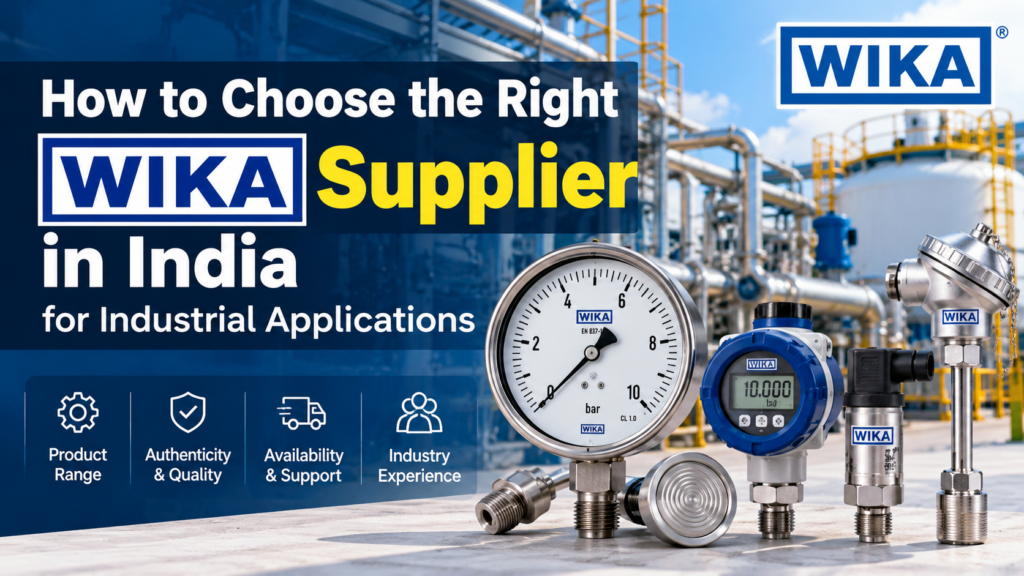
To choose the right WIKA supplier in India, verify their authorized distributor status directly with WIKA, assess their technical expertise in your specific application (pressure, temperature, or level measurement), check their after-sales service and calibration capabilities, and compare lead times against local stock availability. Choose a supplier who offers application engineering support if your process involves hazardous environments or custom specifications.
Choosing a measurement instrumentation supplier is rarely as simple as comparing price lists. For industries relying on WIKA’s pressure gauges, temperature sensors, and level measurement instruments, the supplier you select can directly affect plant uptime, calibration accuracy, and regulatory compliance.
India’s industrial landscape spans everything from oil and gas refineries in Gujarat to pharmaceutical manufacturing in Hyderabad, and each sector has distinct demands for instrumentation reliability. A supplier who excels at supplying standard pressure gauges to a food processing plant may not have the technical depth needed for high-pressure hydraulic systems in a steel mill.
This guide walks through the practical criteria that matter most when evaluating WIKA suppliers in India, so you can make a decision that protects your operations rather than one based solely on cost comparisons.
Why Does Supplier Selection Matter for WIKA Instruments?
The quality of your instrumentation supplier affects far more than the initial purchase price. WIKA manufactures precision instruments for pressure, temperature, level, and flow measurement, and these devices often serve as the frontline indicators for process safety and quality control.
A supplier with weak technical support can leave you stranded when a gauge fails during a critical production run. One with inconsistent inventory can cause costly downtime while you wait for replacement parts to clear customs or travel across the country. Choose your supplier based on their ability to support your operations over the full lifecycle of the instrument, not just the sale.
How Do You Verify an Authorized WIKA Distributor in India?
Authenticity matters when sourcing precision instrumentation. Counterfeit or grey-market products can compromise accuracy, void warranties, and create safety risks in critical applications.
Check WIKA’s Official Channel Partner Listings
WIKA India maintains relationships with authorized channel partners and distributors across the country. Before committing to a supplier, confirm their status directly with WIKA India’s regional office or through the company’s official contact channels. This step protects you from counterfeit products that may look identical but lack the calibration precision and material certifications of genuine WIKA instruments.
Request Documentation and Certificates
A legitimate supplier should readily provide:
- Calibration certificates traceable to national or international standards
- Material test certificates (MTCs) for components in contact with process media
- Country of origin documentation
- WIKA’s own quality certifications (such as ISO 9001)
Suppliers who hesitate or cannot produce this documentation should raise concerns, regardless of how competitive their pricing appears.
What Technical Expertise Should a WIKA Supplier Have?
Not every supplier carrying WIKA products understands the application nuances that determine which instrument variant is appropriate for your process.
Application-Specific Knowledge
WIKA’s product range covers diverse measurement needs: bourdon tube pressure gauges, diaphragm seals for corrosive media, thermocouples and RTDs for temperature measurement, and radar or guided wave radar instruments for level sensing. A supplier with genuine technical depth will ask about your process conditions—temperature extremes, media compatibility, vibration, and hazardous area classifications—before recommending a specific model.
Choose a supplier with in-house application engineers if your facility operates in sectors like petrochemicals, pharmaceuticals, or power generation, where incorrect instrument selection carries safety and compliance consequences. For simpler applications, such as compressed air monitoring in a general manufacturing setting, a supplier with solid general knowledge may be entirely sufficient.
Hazardous Area Certification Knowledge
If your facility operates in explosive atmospheres, your supplier needs to understand ATEX, IECEx, or PESO (Petroleum and Explosives Safety Organisation) certification requirements relevant to India. A supplier unfamiliar with these distinctions could recommend instruments that fail to meet your site’s safety classification, creating compliance gaps during audits.
How Important Is After-Sales Service and Calibration Support?
Instrumentation isn’t a one-time purchase. Pressure and temperature instruments require periodic calibration to maintain accuracy, and failures do occur even with high-quality products.
On-Site Calibration Capabilities
Ask prospective suppliers whether they offer on-site calibration services or whether instruments must be shipped elsewhere for recalibration. For facilities running continuous processes, sending critical gauges off-site for weeks at a time isn’t practical. Suppliers with local, NABL-accredited calibration labs can significantly reduce turnaround time.
Repair and Replacement Turnaround
Ask about typical repair timelines and whether loaner instruments are available while yours is being serviced. A supplier’s responsiveness during a breakdown reveals more about their service quality than any sales pitch.
Spare Parts Availability
Confirm whether the supplier maintains local stock of commonly needed spare parts, such as diaphragm seals, sensing elements, and gaskets. Suppliers who must order parts directly from Germany or other manufacturing locations each time can introduce weeks of delay into what should be a routine repair.
How Do Lead Times and Inventory Affect Your Choice?
India’s size and logistics complexity mean lead times can vary dramatically between suppliers, even for identical products.
Local Stock vs. Made-to-Order
Some WIKA suppliers maintain substantial local inventory of standard products, enabling same-week or next-week delivery. Others operate primarily as order-and-import businesses, with lead times stretching to several weeks or months for non-standard configurations. Clarify which category your prospective supplier falls into, particularly if your projects have tight commissioning schedules.
Regional Presence
Choose a supplier with a physical presence—warehouse, service center, or technical office—near your facility if speed of response matters for your operations. A supplier based in Mumbai may struggle to provide timely on-site support for a facility in Chennai or Kolkata, even if they’re otherwise well-regarded.
How Should You Compare Pricing Among WIKA Suppliers?
Price comparison for industrial instrumentation requires more nuance than comparing unit costs alone.
Total Cost of Ownership
Factor in calibration costs, expected instrument lifespan, warranty terms, and the cost of potential downtime from service delays. A supplier offering instruments at a 10% discount but with no local calibration support or slow replacement turnaround may cost significantly more over a five-year period than a supplier charging slightly more upfront.
Volume and Contract Pricing
If your facility requires recurring instrumentation purchases, negotiate volume-based pricing or annual maintenance contracts (AMCs) that bundle calibration and preventive maintenance services. This approach often yields better long-term value than one-off purchases from the lowest bidder each time.
What Red Flags Should You Watch for When Evaluating Suppliers?
- Unwillingness to provide documentation: Legitimate suppliers readily share calibration certificates and origin documentation.
- Significantly below-market pricing: Prices far below typical market rates can indicate counterfeit or grey-market products.
- Vague technical answers: If a supplier can’t clearly explain why a specific instrument variant suits your application, their expertise may be limited.
- No service infrastructure: A supplier with no calibration lab, repair center, or technical support team isn’t positioned to support you after the sale.
- Lack of established industry presence: Newer suppliers with little traceable history in industrial instrumentation warrant extra diligence before signing long-term contracts.
Choosing a Supplier That Supports Your Operations Long-Term
Selecting the right WIKA supplier in India isn’t about finding the lowest quote. It’s about identifying a partner who understands your application, maintains authentic inventory, and provides reliable calibration and service support over the life of your instruments.
Start by shortlisting authorized distributors, verify their credentials directly with WIKA India, and evaluate their technical depth against your specific process requirements. Request references from companies in your industry sector, and don’t hesitate to ask pointed questions about calibration turnaround and spare parts availability. The supplier who answers these questions confidently and transparently is typically the one who will serve your operations well for years to come.
Frequently Asked Questions
How do I confirm a supplier is an authorized WIKA distributor in India?
Contact WIKA India’s regional office directly or check the official WIKA website’s partner listings. Authorized distributors should be able to provide documentation confirming their status without hesitation.
What’s the typical cost difference between authorized and unauthorized WIKA suppliers?
Pricing varies by product and region, but unauthorized or grey-market sources sometimes offer lower prices on instruments that may lack proper calibration certification or genuine components. Verifying authenticity should take priority over pursuing the lowest listed price.
Do WIKA suppliers in India offer calibration services?
Many authorized suppliers operate or partner with NABL-accredited calibration labs. Availability varies by supplier and region, so confirm this directly before finalizing your choice, especially if you require on-site calibration.
What industries most commonly use WIKA instruments in India?
WIKA instruments are widely used across oil and gas, power generation, pharmaceuticals, food and beverage processing, chemicals, and general manufacturing, wherever precise pressure, temperature, or level measurement is required.
Is it better to choose a local supplier or a larger national distributor?
Choose a local supplier if fast on-site service and calibration turnaround are priorities for your facility. Choose a larger national distributor if your organization has multiple facilities across regions and benefits from centralized account management and consistent pricing.