
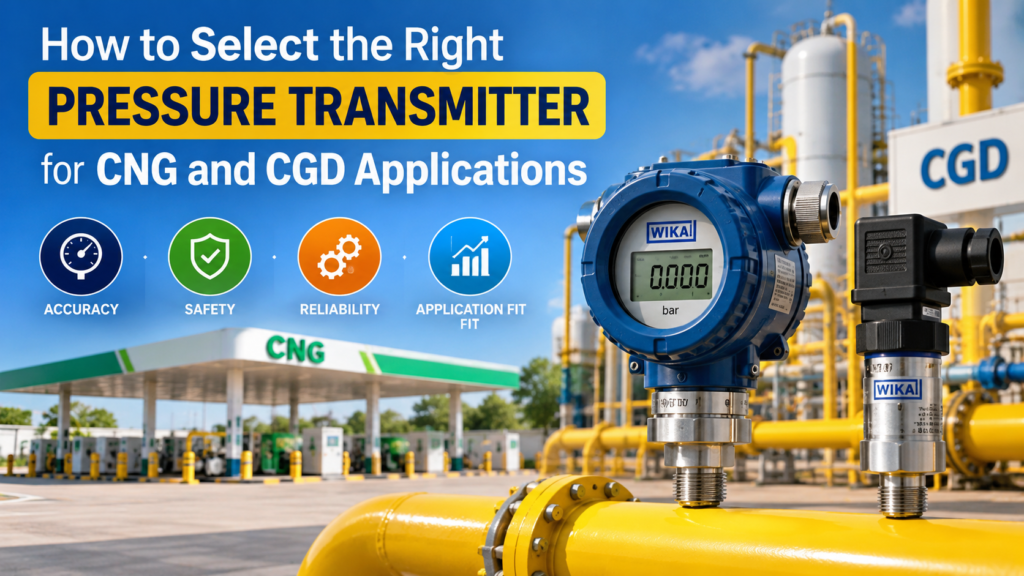
Selecting the right pressure transmitter for CNG and City Gas Distribution (CGD) applications depends on five factors: pressure range, process connection compatibility, hazardous area certification, output signal type, and material compatibility with natural gas. Industrial instrumentation engineers should match these specifications against the specific application—dispensing, compression, or distribution—before finalizing a transmitter, rather than relying on a single “universal” model.
Pressure transmitters are among the most critical instruments in any CNG or CGD installation. They monitor line pressure at compressor stations, dispensing units, mother stations, and daughter booster stations, feeding data that controls safety interlocks, billing accuracy, and process efficiency. A transmitter that’s mismatched to its application—whether through an incorrect pressure range, incompatible wetted material, or missing hazardous area certification—can lead to inaccurate readings, premature failure, or worse, a safety incident in a classified zone.
For EPC contractors and CGD operators in India, the selection process also has to account for local regulatory requirements, including PESO (Petroleum and Explosives Safety Organisation) approvals for equipment used in hazardous gas environments. This guide walks through the technical criteria that matter most, offers a practical comparison framework, and provides a step-by-step checklist for procurement and instrumentation teams.
What Does a Pressure Transmitter Do in a CNG or CGD System?
A pressure transmitter converts physical pressure in a gas line into a standardized electrical signal—typically 4–20mA or a digital protocol like HART—that a control system, PLC, or SCADA network can read. In CNG and CGD applications, transmitters are deployed at multiple points:
- Mother stations: Monitoring high-pressure CNG storage (typically up to 250–300 bar depending on cascade design) for compressor control and safety shutdown.
- Daughter booster stations: Measuring pressure during gas transfer between cascades and dispensing units.
- Online CNG stations: Tracking pressure directly off the City Gas Distribution network before compression.
- Dispensing units: Measuring delivery pressure to vehicles, which directly affects billing accuracy and dispensing safety.
- PNG distribution networks: Monitoring low and medium pressure in residential and commercial gas distribution lines.
Each of these points has different pressure, accuracy, and certification requirements, which is why no single transmitter model works everywhere in a CGD network.
What Pressure Range Should You Choose for CNG Applications?
Pressure range selection should always be based on the maximum operating pressure of the specific line, with an appropriate safety margin—commonly 25–30% above the normal operating pressure, though the exact margin should follow your plant’s engineering standards and the transmitter manufacturer’s recommendations.
Typical CNG system pressure zones include:
- Low pressure (city gas inlet): Generally below 4 bar, depending on the CGD network’s design pressure.
- Medium pressure (post-regulation, pre-compression): Varies by station design, often in the range of 4–19 bar.
- High pressure (compressor discharge, cascade storage): Commonly up to 250 bar, with some cascade systems rated higher depending on design.
Choosing a transmitter with too wide a range for a low-pressure application reduces measurement resolution and accuracy. Conversely, undersizing the range on a high-pressure line risks transmitter damage from overpressure events. Always confirm the exact design pressure from the P&ID and process data sheet before specifying a range—this is application-specific and should never be assumed from general industry figures.
Which Hazardous Area Certifications Are Required for CGD Installations?
CNG dispensing and compression areas are classified as hazardous zones due to the presence of flammable gas. In India, this means instrumentation must carry PESO approval for use in gas installations, in addition to internationally recognized hazardous area certifications such as ATEX or IECEx, depending on the project’s certification requirements and the EPC contractor’s specifications.
Before specifying a transmitter, instrumentation engineers should confirm:
- The specific hazardous area zone classification (Zone 0, 1, or 2) for the installation point, as defined in the area classification drawing.
- Whether PESO approval is mandatory for that specific station type under applicable Indian regulations.
- The ingress protection (IP) rating required for the installation environment, particularly for outdoor or exposed dispensing areas.
Because certification requirements vary by project, location, and regulatory updates, always verify current approval status directly with the manufacturer’s documentation rather than assuming a certification carries over from a previous project.
What Output Signal and Communication Protocol Should You Specify?
Most CNG and CGD applications use a standard 4–20mA analog output, often with HART communication layered on top for diagnostics and remote configuration. The right choice depends on your control system architecture:
- 4–20mA analog: Suitable for simple control loops and legacy SCADA systems without digital integration needs.
- 4–20mA with HART: Preferred where remote diagnostics, configuration, and predictive maintenance data are valuable—common in modern compressor stations.
- Digital fieldbus protocols (e.g., Profibus, Foundation Fieldbus): Used in larger, more integrated plant architectures where multiple instruments share a digital network.
EPC contractors should confirm protocol compatibility with the existing or planned DCS/SCADA system early in the design phase, since retrofitting communication protocols later adds unnecessary cost and project delay.
Why Does Wetted Material Selection Matter for Natural Gas Service?
The wetted parts of a pressure transmitter—the diaphragm and process connection—must be compatible with natural gas composition, including trace moisture, sulfur compounds, and particulates that can occur in field gas. Stainless steel (commonly 316L) is a widely used wetted material in gas service due to its general corrosion resistance, but the correct material grade should always be confirmed against the specific gas composition and any site-specific corrosive conditions identified in the process data sheet.
For applications where gas contains higher moisture or contaminants, engineers may need to specify additional protective measures such as diaphragm seals or filtration upstream of the transmitter. This is a decision that should be made in consultation with the process engineer, not assumed as a standard specification.
How Do You Choose Between Transmitter Accuracy Classes?
Accuracy requirements differ significantly by application:
- Custody transfer and dispensing applications typically demand higher accuracy, since billing and commercial transactions depend on precise measurement.
- General process monitoring (compressor control, line pressure indication) can often use standard industrial accuracy grades without the added cost of custody-transfer-grade instruments.
Choose a higher accuracy class if the transmitter feeds a billing or custody transfer system where measurement discrepancies have financial implications. Choose a standard industrial accuracy class if the transmitter is used purely for process monitoring or safety interlock functions where tight tolerances aren’t commercially critical.
Comparison Table: Pressure Transmitter Selection Criteria by Application
| Application Point | Typical Pressure Range Consideration | Certification Priority | Accuracy Priority | Communication Protocol |
|---|---|---|---|---|
| Mother station (cascade storage) | High pressure, confirm against station design (commonly up to 250 bar) | PESO + hazardous area certification | Standard industrial | 4–20mA with HART |
| Daughter booster station | Medium to high, per transfer design | PESO + hazardous area certification | Standard industrial | 4–20mA with HART |
| Online compressor station | Low to medium, per CGD inlet pressure | PESO + hazardous area certification | Standard industrial | 4–20mA or digital fieldbus |
| Dispensing unit | Medium to high, per dispensing design pressure | PESO + hazardous area certification | Higher accuracy for custody transfer | 4–20mA with HART |
| PNG distribution network | Low pressure, per network design | Hazardous area certification as applicable | Standard industrial | 4–20mA |
Note: Exact pressure values, certification requirements, and accuracy classes must be confirmed against the specific project’s process data sheets and applicable regulatory requirements. This table is a general selection framework, not a substitute for application-specific engineering review.
Step-by-Step Pressure Transmitter Selection Checklist
- Identify the exact installation point in the CNG/CGD system (mother station, dispensing unit, distribution line, etc.).
- Confirm the design pressure and expected overpressure scenarios from the P&ID and process data sheet.
- Determine the hazardous area classification (Zone 0, 1, or 2) for that installation point.
- Verify required certifications, including PESO approval and any applicable ATEX/IECEx certification, directly against current manufacturer documentation.
- Specify wetted material based on actual gas composition and site-specific corrosion risk, in consultation with the process engineer.
- Determine accuracy requirements based on whether the application involves custody transfer/billing or general process monitoring.
- Select the output signal and communication protocol that matches your existing or planned control system architecture.
- Confirm the IP rating needed for the installation environment, especially for outdoor or exposed locations.
- Review manufacturer documentation for installation, calibration, and maintenance requirements before finalizing procurement.
- Consult with an experienced instrumentation supplier, such as MechTech Energies, to validate the final specification against the project’s complete technical and regulatory requirements.
Getting the Specification Right the First Time
Pressure transmitter selection for CNG and CGD applications isn’t a single-step decision. It requires cross-referencing pressure range, hazardous area classification, certification requirements, material compatibility, and accuracy needs against the specific demands of each installation point in the system. Treating every application the same—or assuming a certification or specification carries over from a previous project—creates unnecessary risk.
For instrumentation engineers, EPC contractors, and procurement teams working on CNG and CGD projects in India, the most reliable approach is to validate every specification against current process data and manufacturer documentation before finalizing an order. MechTech Energies works with CGD operators and EPC contractors to help match pressure transmitter specifications to the technical and regulatory requirements of each project, drawing on application-specific engineering review rather than generic recommendations.
Frequently Asked Questions
What pressure transmitter accuracy is required for CNG dispensing stations?
Dispensing applications involving custody transfer or billing generally require higher accuracy classes than general process monitoring points, since measurement precision directly affects commercial transactions. The exact accuracy class should be confirmed with your instrumentation supplier based on the station’s metering and billing requirements.
Is PESO approval mandatory for all pressure transmitters used in CNG stations?
PESO approval requirements depend on the specific application, installation location, and current regulatory guidelines. EPC contractors and operators should confirm PESO requirements for each installation point rather than assuming blanket approval across all transmitter types.
Can the same pressure transmitter be used for both mother stations and dispensing units?
Generally, no. Mother stations and dispensing units often have different pressure ranges, accuracy requirements, and certification needs, so a single transmitter model rarely suits both without careful specification review.
What is the typical lead time for procuring certified pressure transmitters for CGD projects?
Lead times vary depending on the manufacturer, certification requirements, and order volume. Procurement teams should request lead time confirmation directly from their supplier during the quotation stage, particularly for instruments requiring specific hazardous area certifications.
What are the alternatives if a standard pressure transmitter doesn’t meet the application’s material compatibility needs?
In cases where gas composition includes higher moisture or contaminants, diaphragm seals or additional filtration upstream of the transmitter may be specified. This decision should be made jointly with the process engineer based on the site’s specific gas quality data.