
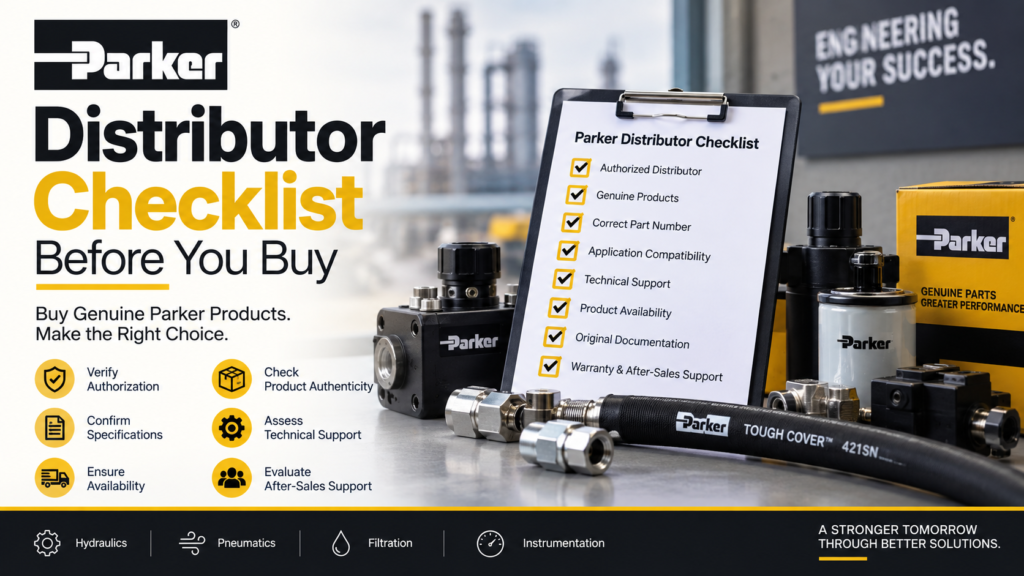
Parker Distributor Checklist Before You Buy: 12 Things to Verify
Buying industrial components is rarely just about finding the lowest price. When the equipment is part of a critical application, the distributor you purchase from can have a direct impact on product authenticity, technical compatibility, delivery timelines, documentation, and after-sales support.
This is particularly important when purchasing products from a globally recognized manufacturer such as Parker. Parker products are used across a wide range of industrial applications, including fluid and gas handling, instrumentation, hydraulics, pneumatics, filtration, process control, and energy infrastructure.
But finding a company that sells Parker products is not necessarily the same as finding the right Parker distributor.
Before placing an order, buyers should verify the distributor’s credentials, product authenticity, technical capabilities, documentation, availability, and support.
This Parker distributor checklist covers the most important things to check before you buy.
Quick Parker Distributor Checklist
Before purchasing Parker products, verify these 12 points:
- Distributor or channel-partner credentials
- Product authenticity
- Correct Parker product series
- Exact part number and specifications
- Application compatibility
- Technical support capability
- Product availability and lead time
- Original documentation
- Pricing and quotation transparency
- Installation and commissioning support
- Warranty and after-sales support
- Distributor experience in your industry
A reliable distributor should be able to answer these questions clearly rather than simply providing a product price.
1. Verify the Distributor’s Credentials
The first step is to determine who you are actually buying from.
Many industrial suppliers list well-known brands on their websites, but buyers should still verify the supplier’s relationship with the manufacturer and understand what type of distribution or supply arrangement they have.
When evaluating a Parker distributor, look for clear information about:
- Company name and legal identity
- Business address
- Contact information
- Industry experience
- Parker product categories supplied
- Distribution or channel credentials
- Technical capabilities
- Customer support
- Relevant project experience
A professional industrial distributor should be comfortable providing information about its business and the products it supplies.
Why this matters
Buying from an established distributor can make it easier to verify product origin, obtain technical documentation, resolve specification questions, and receive support after the sale.
Do not select a supplier based only on a product photograph and a low quotation.
2. Confirm That the Parker Product Is Genuine
Product authenticity is one of the most important considerations when buying industrial components.
A genuine product should have appropriate manufacturer identification, part-number information, packaging or labeling where applicable, and supporting documentation.
Depending on the product category, buyers may need to verify:
- Parker branding
- Product identification
- Part number
- Series or model
- Manufacturer documentation
- Packaging
- Certificates or test documentation where applicable
- Traceability requirements
The exact documentation will vary according to the product and application.
If a supplier cannot clearly explain the product’s origin or provide appropriate documentation, that should be treated as a warning sign.
Don’t compare products only by appearance
Two components can look similar while having significantly different:
- Pressure ratings
- Materials
- Connection types
- Temperature ratings
- Flow characteristics
- Seal materials
- Certifications
- Application limitations
For industrial systems, visual similarity is not enough.
3. Check the Exact Parker Part Number
One of the most common purchasing mistakes is ordering the right product family but the wrong configuration.
Parker offers products in many series and configurations. A valve, fitting, hose, filter, manifold, regulator, or instrumentation component may have multiple variants designed for different applications.
Before approving a quotation, compare the supplier’s proposed part number with your requirement.
Check:
- Product family
- Series
- Part number
- Size
- Port or connection type
- Material
- Pressure rating
- Temperature range
- Seal or elastomer specification
- End connection
- Configuration
- Optional features
Ask the distributor to confirm the complete part number
If you provide a distributor with a technical requirement rather than an exact part number, ask them to confirm the recommended Parker part number in writing.
This creates a clear technical reference before the purchase order is issued.
4. Make Sure the Product Is Suitable for Your Application
A genuine Parker product can still be the wrong product for your application.
The correct selection depends on the operating conditions of your system.
Before buying, discuss factors such as:
Pressure
Determine the normal and maximum operating pressure.
The component should be suitable for the actual system pressure, including relevant safety margins.
Temperature
Check the operating and ambient temperature range.
Seal materials and other component characteristics can affect temperature suitability.
Fluid or Gas
Identify exactly what the component will handle.
For example, compatibility requirements can differ significantly between:
- Compressed air
- Water
- Hydraulic oil
- Natural gas
- CNG
- Hydrogen
- LPG
- Chemicals
- Other process fluids
Flow Requirements
For flow-control components, the required flow rate and pressure drop may influence product selection.
Environment
Consider environmental conditions such as:
- Outdoor installation
- Corrosive environments
- Humidity
- Dust
- Vibration
- Temperature variations
A good distributor should ask these questions before recommending a component.
5. Evaluate the Distributor’s Technical Support
A distributor should provide more than a quotation.
Industrial buyers often need help selecting the correct component, understanding specifications, interpreting datasheets, or determining compatibility with an existing system.
Before buying, ask:
- Can the distributor help with product selection?
- Can they interpret Parker specifications?
- Can they recommend an appropriate product series?
- Can they review your application requirements?
- Can they provide technical documentation?
- Can they support troubleshooting?
- Can they coordinate with the manufacturer when necessary?
Technical support becomes especially valuable when the product is being used in a new installation or a critical industrial application.
Price is only one part of the purchase
A slightly cheaper component is not necessarily cheaper if incorrect selection causes:
- Installation delays
- Rework
- Equipment downtime
- Leakage
- Premature failure
- Replacement costs
Technical support can reduce these risks.
6. Check Product Availability and Lead Time
Availability is another important part of the purchasing decision.
A distributor may quote a product without having it physically available.
Ask whether the product is:
- In stock
- Available from a local warehouse
- Available through the manufacturer’s supply chain
- Made to order
- Subject to a specific lead time
Also ask whether the quoted delivery date is:
- Estimated
- Confirmed
- Dependent on manufacturer availability
Why lead time matters
For plant maintenance or project installations, a delayed component can affect the entire schedule.
For larger projects, buyers should ideally confirm availability before finalizing procurement schedules.
A reliable distributor should provide realistic delivery information rather than promising an unrealistic date simply to secure the order.
7. Ask for the Relevant Product Documentation
Documentation is particularly important for industrial equipment.
Depending on the product and application, documentation may include:
- Product datasheets
- Technical specifications
- Installation instructions
- Operation manuals
- Product drawings
- Dimensional information
- Material information
- Certificates
- Test documentation
- Compliance information
The exact documentation required will depend on the Parker product and your project requirements.
Documentation helps with more than purchasing
Proper documentation can also help your:
- Engineering team
- Procurement department
- Maintenance team
- Quality team
- Project management team
It can also make future replacement and maintenance easier.
8. Compare the Quotation Properly
When comparing two Parker distributor quotations, don’t compare only the final price.
Create a comparison based on the complete supply.
For example:
| Factor | What to Check |
|---|---|
| Manufacturer | Parker |
| Part Number | Exact configuration |
| Quantity | Required quantity |
| Unit Price | Per-unit cost |
| Taxes | Clearly specified |
| Freight | Included or additional |
| Delivery | Confirmed lead time |
| Documentation | Included |
| Warranty | Terms and duration |
| Technical Support | Available or not |
| After-Sales Support | Clearly defined |
A quotation that appears cheaper initially may become more expensive after freight, taxes, documentation, or other charges are added.
Ask for an itemized quotation
An itemized quotation makes it easier to compare suppliers on a like-for-like basis.
9. Check Warranty and After-Sales Support
Before purchasing, understand what happens if the product arrives damaged, does not match the ordered specification, or develops a problem.
Ask the distributor about:
- Warranty coverage
- Warranty period
- Claim procedure
- Replacement process
- Technical troubleshooting
- Return conditions
- Support contact
- Manufacturer involvement where applicable
For industrial components, after-sales support can be particularly important when the product is integrated into a larger system.
A distributor that remains available after the invoice is issued provides additional value to the buyer.
10. Look for Relevant Industry Experience
Not every distributor has the same level of application experience.
A supplier may sell Parker products but have limited knowledge of your specific industry.
Before choosing a distributor, consider whether they understand applications such as:
- Industrial automation
- Hydraulics
- Pneumatics
- Instrumentation
- Process systems
- Oil and gas
- CNG infrastructure
- CBG applications
- Energy systems
- Industrial gas systems
- Manufacturing
- Fluid handling
Industry experience can make product selection faster and reduce the possibility of specification errors.
Ask application-specific questions
Instead of asking only:
“Do you supply Parker products?”
ask:
“Can you help us select the correct Parker component for this application?”
The second question provides much more useful information about the distributor’s technical capability.
11. Check Whether the Distributor Understands Your Complete Requirement
For many projects, the requirement is not limited to one component.
You may need several products that must work together as part of a larger system.
For example, a project could involve:
- Valves
- Fittings
- Tubing
- Hoses
- Filters
- Regulators
- Manifolds
- Instrumentation components
- Connectors
- Other fluid or gas handling components
A distributor that understands the complete system can potentially help coordinate the component selection instead of treating every item as an isolated purchase.
This can simplify procurement and technical coordination.
12. Evaluate Communication and Responsiveness
This point is often overlooked.
The purchasing process gives you an early indication of what future support may look like.
Pay attention to how quickly and accurately the distributor responds to:
- Technical questions
- Part-number requests
- Datasheet requests
- Availability questions
- Lead-time confirmation
- Quotation revisions
- Documentation requirements
A distributor that provides clear answers before the sale is generally easier to work with during a project.
Watch for vague answers
Be cautious if the supplier repeatedly responds with:
- “It should work.”
- “This is the same.”
- “Delivery will be soon.”
- “Documentation can be provided later.”
- “The part number doesn’t matter.”
Industrial procurement requires precise information.
Parker Distributor Red Flags to Watch For
A buyer should be cautious when a supplier:
1. Avoids providing a precise part number
The exact configuration matters.
2. Cannot explain product origin
Ask where the product is sourced and what documentation is available.
3. Offers an unusually low price without explanation
Price differences can have legitimate reasons, but they should be understood.
4. Provides generic specifications
A professional quotation should identify the specific product being supplied.
5. Cannot provide technical documentation
Documentation should be available according to the product and application requirements.
6. Promises unrealistic delivery
Always request a realistic and preferably confirmed lead time.
7. Has no technical support
If the distributor cannot assist with product selection or application questions, consider whether they are suitable for your project.
8. Changes the proposed product without explanation
Any substitution should be clearly identified and technically evaluated before approval.
Questions to Ask a Parker Distributor Before Buying
Before issuing a purchase order, ask the following questions:
1. What is the exact Parker part number?
2. Is the quoted product the exact configuration required for our application?
3. Can you provide the relevant technical datasheet?
4. What is the product’s availability?
5. What is the confirmed or estimated lead time?
6. What documentation will be supplied?
7. What are the applicable warranty terms?
8. Is technical support available after purchase?
9. Are there any additional freight, tax, or handling charges?
10. Can you support product selection if our application requirements change?
Getting these questions answered before purchasing can prevent many common procurement problems.
Parker Distributor Checklist for CNG, Gas and Energy Applications
Buyers working on CNG, CBG, LPG, hydrogen, or other gas-related infrastructure should apply additional scrutiny.
Gas-handling applications can involve demanding operating conditions and strict technical requirements.
Before purchasing components, consider:
- Gas compatibility
- Pressure requirements
- Temperature range
- Material compatibility
- Connection standards
- Sealing requirements
- Applicable certifications
- Installation environment
- Maintenance requirements
- Documentation and traceability
For critical gas infrastructure, product selection should be based on engineering requirements rather than simply choosing the closest-looking component.
The distributor should understand the application and provide technically appropriate products for the intended service.
Why Choosing the Right Parker Distributor Matters
The distributor is an important part of the industrial supply chain.
A strong distributor can help connect the manufacturer’s product portfolio with the actual requirements of your project.
The value can include:
- Product selection assistance
- Availability information
- Technical documentation
- Application guidance
- Procurement support
- Delivery coordination
- Installation assistance
- After-sales support
This becomes increasingly important when purchasing components for complex industrial systems.
Instead of asking only, “Where can I buy Parker products?”, buyers should ask:
“Which Parker distributor can supply the right product, provide the right documentation, and support the application?”
That is a much better purchasing question.
Why Buyers Should Consider MechTech Energies & Consultants
For buyers in India looking for Parker products and application support, MechTech Energies & Consultants provides an industrial-focused approach to Parker product supply and technical requirements.
The company works with industrial customers requiring Parker solutions across areas such as fluid handling, instrumentation, energy infrastructure, and related applications.
For a project requirement, buyers can share details such as:
- Required Parker product
- Existing part number
- Application
- Operating pressure
- Operating temperature
- Fluid or gas
- Quantity
- Project location
- Required delivery timeline
Providing this information allows the supplier to understand the requirement more accurately and recommend the appropriate product or configuration where technical assistance is required.
If you already have a Parker part number, include it in your inquiry to reduce the possibility of selecting the wrong configuration.
Final Parker Distributor Checklist
Before you buy, run through this final checklist:
☐ Verify the distributor’s business credentials
☐ Confirm the Parker product and exact part number
☐ Verify product authenticity and documentation
☐ Check pressure and temperature requirements
☐ Confirm fluid or gas compatibility
☐ Verify connection and dimensional requirements
☐ Check product availability
☐ Confirm lead time
☐ Request relevant datasheets and technical documents
☐ Compare complete quotations rather than only unit prices
☐ Review warranty terms
☐ Confirm after-sales support
☐ Evaluate technical expertise
☐ Check industry/application experience
☐ Confirm all requirements before issuing the purchase order
If all of these points have been checked, you are in a much stronger position to make an informed Parker product purchasing decision.
Conclusion
Choosing a Parker distributor should not be treated as a simple price-comparison exercise.
The right distributor can help you verify the correct product, understand technical specifications, arrange documentation, confirm availability, and provide support throughout the purchasing and application process.
Before buying Parker products, verify the distributor, exact part number, application compatibility, documentation, availability, warranty, technical support, and after-sales service.
A few minutes spent checking these details before placing an order can help prevent costly procurement and installation problems later.
Use this Parker Distributor Checklist before your next purchase and make sure the product, supplier, specifications, and support all meet your project requirements.
For Parker product requirements in India, you can contact MechTech Energies & Consultants with your product details, part number, application requirements, and quantity for further assistance.