
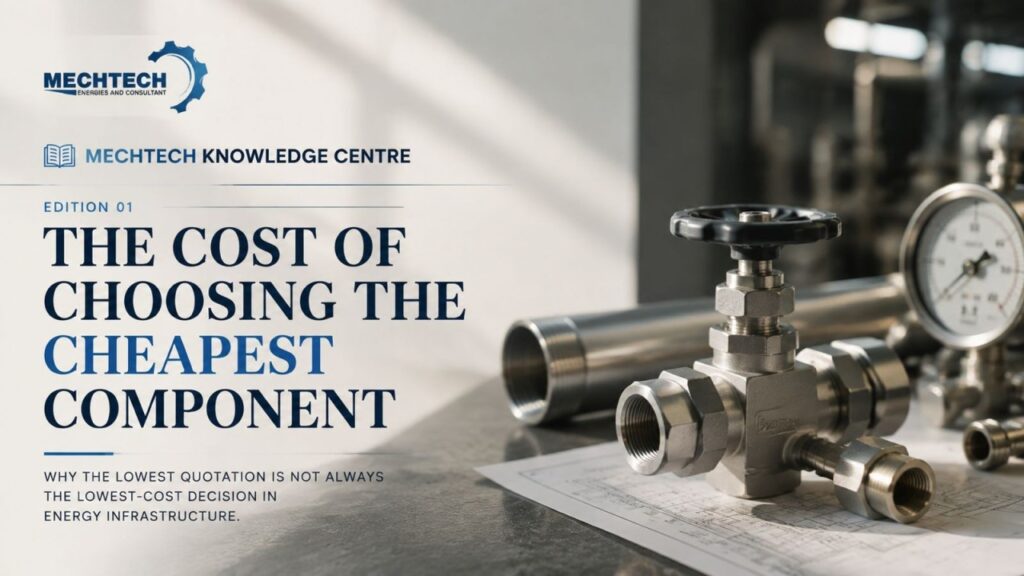
Why the lowest quotation is not always the lowest-cost decision in energy infrastructure
The cheapest component is often the most expensive decision you make.
In energy infrastructure, every component has a role to play.
A fitting, valve, hose, filter, gauge, or connector may look like a small part of a much larger system.
But in high-pressure applications, small components often carry the biggest responsibility.
The mistake many organisations make is evaluating components only on purchase price.
A lower initial cost may look attractive on a quotation sheet.
But the real cost appears later through:
- Unplanned downtime
- Maintenance requirements
- Replacement costs
- Documentation gaps
- Safety concerns
- Operational delays
A component is not just a product.
It is part of a system that has to perform reliably for years.
The difference is often invisible
Two components may appear identical from the outside.
The same size.
The same connection.
The same application.
But engineering reliability depends on factors that are not always visible:
Material quality
The material selected, manufacturing process, and consistency directly impact long-term performance.
Pressure capability
A component working at high pressure is not just about surviving the pressure once. It is about maintaining performance repeatedly under operating conditions.
Traceability
For critical systems, knowing the origin, specifications, and documentation of a component matters.
Testing and qualification
A component that is engineered, tested, and supported by an established OEM brings confidence beyond the physical product.
Why OEM selection matters
In critical applications, the question should not only be:
“How much does this component cost?”
The better question is:
“Can we rely on this component when the system is operating under pressure?”
This is where OEM expertise becomes important.
Companies like Parker Hannifin have built specialised solutions for high-pressure applications, including CNG systems, instrumentation, fittings, valves, filtration and fluid control components.
Similarly, specialised CNG equipment providers such as OPW Global focus on engineered fueling components including nozzles, breakaways, hose assemblies, fittings, valves and filters designed for demanding fueling applications.
The value is not only in the component itself.
It is in the engineering behind it.
The MechTech approach
At MechTech, we believe procurement is not about finding the cheapest option.
It is about finding the right solution for the application.
That means understanding:
- Operating conditions
- System requirements
- Safety considerations
- Documentation needs
- Long-term reliability
Sometimes the right recommendation is not the most expensive option.
Sometimes it is not even the product initially requested.
The responsibility is to recommend what is technically right.
Because our clients should not pay for our learning curve.
Good procurement reduces uncertainty.
Good engineering reduces risk.
And in energy infrastructure, the right decision is the one that continues to perform long after installation.