
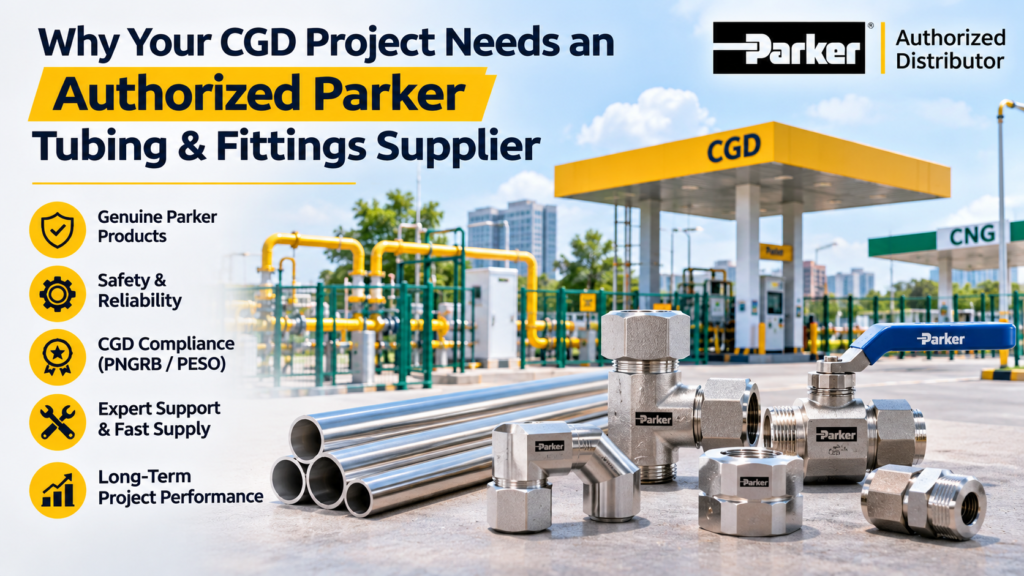
An authorized Parker distributor supplies genuine, traceable instrumentation tubing and fittings backed by manufacturer certification, technical support, and warranty protection. For City Gas Distribution (CGD) projects, where leak-proof connections and regulatory compliance are non-negotiable, sourcing from an authorized supplier reduces the risk of counterfeit components, installation failures, and compliance gaps that can delay commissioning or compromise safety.
City Gas Distribution networks move natural gas through a tightly controlled system of pipelines, regulators, and metering stations, all the way to homes, businesses, and vehicles. Every joint, valve, and tube fitting in that chain carries real consequences if it fails. A single substandard fitting can mean a gas leak, a safety incident, or a costly shutdown during an audit.
That’s why the choice of tubing and fittings supplier matters as much as the choice of pipe material or pressure rating. Parker Hannifin has built decades of engineering credibility in instrumentation connections, and its tubing and fittings are specified across oil and gas, petrochemical, and gas distribution projects worldwide. But not every seller claiming to carry “Parker products” is actually authorized to sell them.
This post breaks down what an authorized Parker supplier actually provides, why it matters specifically for CGD infrastructure, and how to evaluate a supplier before you commit a project budget to them.
What Does “Authorized Parker Distributor” Actually Mean?
An authorized Parker distributor is a company that Parker Hannifin has formally approved to sell its genuine instrumentation products, including tube fittings, valves, and tubing assemblies. This authorization isn’t just a marketing label. It typically comes with:
- Direct supply chain access to Parker’s manufacturing facilities, which means products arrive with intact traceability records.
- Technical training on proper installation, torque specifications, and fitting selection for specific applications.
- Warranty backing directly from Parker, rather than a third-party reseller with no accountability to the manufacturer.
- Access to genuine certifications, including material test reports and compliance documentation that regulators and auditors require.
Unauthorized resellers, by contrast, may source products through gray-market channels, mix counterfeit components with genuine ones, or sell older, discontinued stock without proper documentation. For most industrial applications, that’s a quality risk. For CGD infrastructure carrying pressurized natural gas into populated areas, it’s a safety risk.
Why Does Supplier Authorization Matter More in CGD Projects?
CGD networks operate under strict regulatory oversight because they deliver combustible gas directly into residential, commercial, and automotive settings. Instrumentation tubing and fittings sit at pressure-critical points throughout this system, including regulator stations, metering skids, and control panels.
What happens if a fitting fails in a gas distribution system?
A failed fitting in a CGD application can result in gas leakage, pressure instability, or a forced shutdown of part of the distribution network. Beyond the immediate safety concern, operators face regulatory penalties, reputational damage, and the cost of emergency repairs. Because CGD projects are inspected and licensed by regulatory authorities, any component that can’t be traced back to a verified, authorized source may fail an audit even if it performs adequately in the field.
Does regulatory compliance require authorized sourcing?
Regulatory bodies overseeing gas distribution infrastructure generally require documented proof of component origin, including material certificates and manufacturer traceability. An authorized Parker supplier can provide this documentation as a standard part of the sale. A gray-market reseller often cannot, which puts the entire project’s compliance paperwork at risk during commissioning or renewal inspections.
What Should You Look for in an Authorized Parker Supplier?
Choosing the right supplier for instrumentation tubing and fittings goes beyond checking a logo on a website. Here’s what to verify before signing a purchase order.
How do I verify a supplier is genuinely authorized?
Ask the supplier directly for their Parker distributor authorization number or certificate, and cross-check it against Parker’s official distributor locator. A legitimate authorized distributor will have no hesitation providing this. If a supplier is vague about their authorization status or can’t produce documentation, treat that as a warning sign.
What product range should the supplier carry?
For CGD applications specifically, look for suppliers who stock the full range relevant to gas distribution instrumentation: compression tube fittings, instrumentation valves, stainless steel tubing, and associated adapters. A supplier with a narrow or inconsistent inventory may substitute non-Parker components when stock runs short, which defeats the purpose of sourcing from an authorized channel in the first place.
Does the supplier offer technical and application support?
Instrumentation tubing in CGD systems often needs to be sized, routed, and torqued precisely for the application. Choose a supplier whose technical team can advise on proper fitting selection, installation procedures, and pressure ratings for your specific project conditions, not just one that processes orders.
Can the supplier support project timelines?
CGD projects frequently run on regulatory deadlines tied to network rollout phases. Choose an authorized supplier if your project timeline, documentation requirements, and safety margins matter more than finding the lowest unit price from an unverified source. Lead time reliability and stock availability should factor into the decision as heavily as per-unit cost.
Counterfeit Fittings: A Risk That’s Easy to Underestimate
Counterfeit or gray-market tube fittings can look nearly identical to genuine Parker products, down to the markings stamped on the fitting body. The difference shows up under pressure, literally. Material composition, machining tolerances, and ferrule hardness all affect whether a fitting seals correctly and holds under the pressure cycling typical of gas distribution systems.
Because these defects aren’t visible during installation, a counterfeit fitting can pass initial pressure testing and still fail months later under field conditions. That delayed failure mode is part of what makes counterfeit components so dangerous in CGD infrastructure, where failures often occur in locations with limited monitoring.
Sourcing exclusively through an authorized Parker distributor removes this risk at the point of purchase, rather than leaving it to be discovered during operation.
Building a Reliable Procurement Process for CGD Instrumentation
Project engineers and procurement teams working on CGD infrastructure benefit from establishing a standing relationship with an authorized supplier rather than sourcing fittings project-by-project from whichever vendor quotes the lowest price. A consistent supplier relationship offers:
- Faster turnaround on repeat orders, since the supplier already understands your specifications and documentation requirements.
- Consistent quality, since every shipment traces back to the same verified source.
- Simplified audits, since all component documentation follows a predictable format and chain of custody.
- Better technical continuity, since the same support team understands your system’s history and prior installations.
This approach also reduces administrative burden. Instead of re-verifying authorization and compliance documents for every new vendor on every project, procurement teams can rely on an established, vetted relationship.
Choosing the Right Partner for Long-Term CGD Projects
City Gas Distribution networks are built to operate for decades, which means the components installed today will be relied upon long after the original project team has moved on. Choose an authorized Parker supplier if your project values long-term safety, regulatory compliance, and traceable documentation over short-term cost savings. For infrastructure that carries gas into homes and businesses, the margin for error on tubing and fittings is effectively zero.
Before your next procurement cycle, take the time to verify your supplier’s authorization status directly with Parker, request full documentation on your next order, and evaluate whether your current vendor can support the technical and compliance demands your CGD project requires. A genuine, authorized sourcing relationship protects not just your project timeline, but the safety of everyone the network ultimately serves.
Frequently Asked Questions
What does CGD stand for in the context of gas infrastructure?
CGD stands for City Gas Distribution, which refers to the network of pipelines, regulators, and metering equipment that delivers natural gas to residential, commercial, and automotive end users within a city or region.
How much more does an authorized Parker supplier cost compared to a gray-market reseller?
Pricing varies by region and order volume, so there’s no universal figure. However, any price difference should be weighed against the cost of potential leaks, failed audits, project delays, and liability exposure that can come from unverified components.
What documentation should I receive when buying from an authorized Parker distributor?
You should expect material test certificates, traceability records linking the product to Parker’s manufacturing facility, and proof of the distributor’s current authorization status.
Are counterfeit Parker fittings common in the instrumentation market?
Counterfeit and gray-market industrial components are a recognized risk across multiple industries, including oil and gas and instrumentation supply chains. Sourcing exclusively from verified, authorized distributors is the most direct way to avoid this risk.
Can I switch to an authorized supplier mid-project without disrupting my timeline?
Yes, in most cases. Many authorized distributors can match existing specifications and expedite initial orders to minimize disruption, though lead times will depend on the specific components and order volume involved.